Written by the Kanen Coffee service team. We service commercial grinders in Bay Area cafes weekly and we hear the same complaint from every owner: "the grinder is too loud." For open-kitchen cafes, brunch restaurants, and offices with hot-desking right next to the coffee station, grinder noise is a real customer-experience and HR problem. Here's what actually quiet sounds like — and which commercial grinders deliver it.
How Loud Are Commercial Grinders, Really?
A typical commercial flat-burr grinder runs 75–85 dB at the operator's ear during a grind. For comparison: an average office is ~55 dB, a normal conversation is ~60 dB, and a vacuum cleaner is ~70 dB. A loud grinder is, literally, louder than a vacuum cleaner — and your customers and barista hear it every 30 seconds.
"Quiet" commercial grinders run 62–72 dB. That's a meaningful difference. At 65 dB you can hold a conversation a few feet away. At 80 dB you can't.
What Actually Makes a Grinder Quiet
- Lower RPM motors. A motor that spins at 900 RPM is dramatically quieter than one at 1700 RPM. The trade-off: lower RPM grinders are slightly slower per shot. For most cafes, this is invisible — the workflow bottleneck is rarely the grinder.
- Larger burrs at lower speed. 83mm+ flat burrs spinning slowly cut through coffee with less impact noise than 64mm burrs spinning fast.
- Vibration dampening. Heavier motors mounted on isolated rubber/sorbothane chassis transmit less mechanical noise into countertops and cabinetry.
- Sealed chambers. Some commercial grinders enclose the burr chamber more thoroughly than others — meaningful difference in airborne grind noise.
The Quietest Commercial Grinders You Can Actually Buy
Mahlkönig E65S GbW
Mahlkönig's E65 platform runs notably quieter than the older K30 family. The GbW (Grind by Weight) variant adds load-cell weighing, which means baristas pull less often and the grinder runs less per day. ~70 dB during a grind. Considered the current quiet-grinder benchmark in the third-wave world. Sub-second response to dose changes. Typical Bay Area cafe budget: $4,500–$6,500.
Mythos 2 / Mythos MyG
Nuova Simonelli's Mythos line is famously fast and famously well-engineered. The Mythos 2 (current) runs ~72 dB and has cooled burrs for thermal stability across high-volume shifts. The MyG variant adds gravimetric dosing. Heavy and rock-solid on the bench. Typical price: $3,500–$4,800.
Eureka Atom Specialty 75
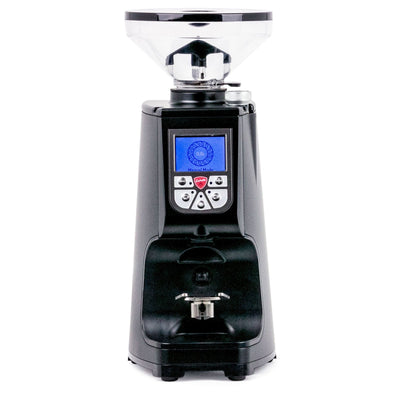
The Atom 75 isn't strictly commercial — it's prosumer/light-commercial — but for small specialty cafes (under 80 drinks/day) it's the quietest grinder in this entire roundup at ~62 dB. Single-dose-friendly. Worth considering for a quiet brunch cafe or an office. ~$1,500.
Mahlkönig EK43 (the surprise pick)
The EK43 isn't quiet (~75 dB) — but it's smoother and less harsh than smaller fast-spinning grinders. For cafes that already accept some grinder noise, the EK43's character is "industrial roar" rather than "shrieking whine," which most customers and staff find easier to tolerate. $3,500–$4,500.
Grinders to Avoid If Noise Is a Priority
Without naming brands harshly: most sub-$1,500 commercial grinders use small fast-spinning burrs in light chassis. They get the coffee ground, but they're loud and they transmit vibration. For a quiet cafe build, you have to invest in the grinder — there isn't a $500 quiet commercial option.
Setup Tips That Make Any Grinder Quieter
- Sorbothane or thick rubber feet under the grinder. A $40 set of vibration-isolation feet can drop perceived noise meaningfully by killing chassis-to-countertop transmission.
- Don't put the grinder on a hollow cabinet. Hollow casework is a drum. Solid stone, butcher block, or insulated stainless prep tables are dramatically quieter than thin laminate counters.
- Single-dose if your volume allows. Pre-weighing doses means you grind exactly what you need with zero overflow noise from the chute.
- Replace burrs on schedule. Worn burrs are louder than fresh burrs. Most commercial cafes need new burrs every 600–1,000 lbs of coffee.
Match the Grinder to the Machine
A quiet $5,500 grinder paired with a $12,000+ commercial machine is the right ratio. The two most common spec mistakes we see:
- $22,000 Linea PB paired with a $1,200 grinder. The grinder becomes the cup-quality ceiling, and probably the noise problem too. Bump the grinder budget.
- $5,500 grinder paired with a $4,000 single-boiler machine. Over-spec'd for the boiler. Save money on the grinder and put it toward a dual-boiler.
How to Buy a Commercial Grinder from Kanen Coffee
We carry the Eureka and Lucca grinder lines on the showroom floor at 2319 4th St, Berkeley. For Mahlkönig and Mythos commercial grinders, we coordinate orders through our manufacturer relationships and handle delivery, install, and burr replacement for Bay Area cafes.
Talk to our team about a quiet commercial grinder
We'll match the right grinder to your machine, volume, and budget — and your sound budget. (510) 859-4425 or request a quote.
Browse grinders →